While My Guitar Gently Weeps by The Beatles
George Harrison wrote While My Guitar Gently Weeps for the Beatles' 1968 White Album, with an uncredited lead guitar part by Eric Clapton.
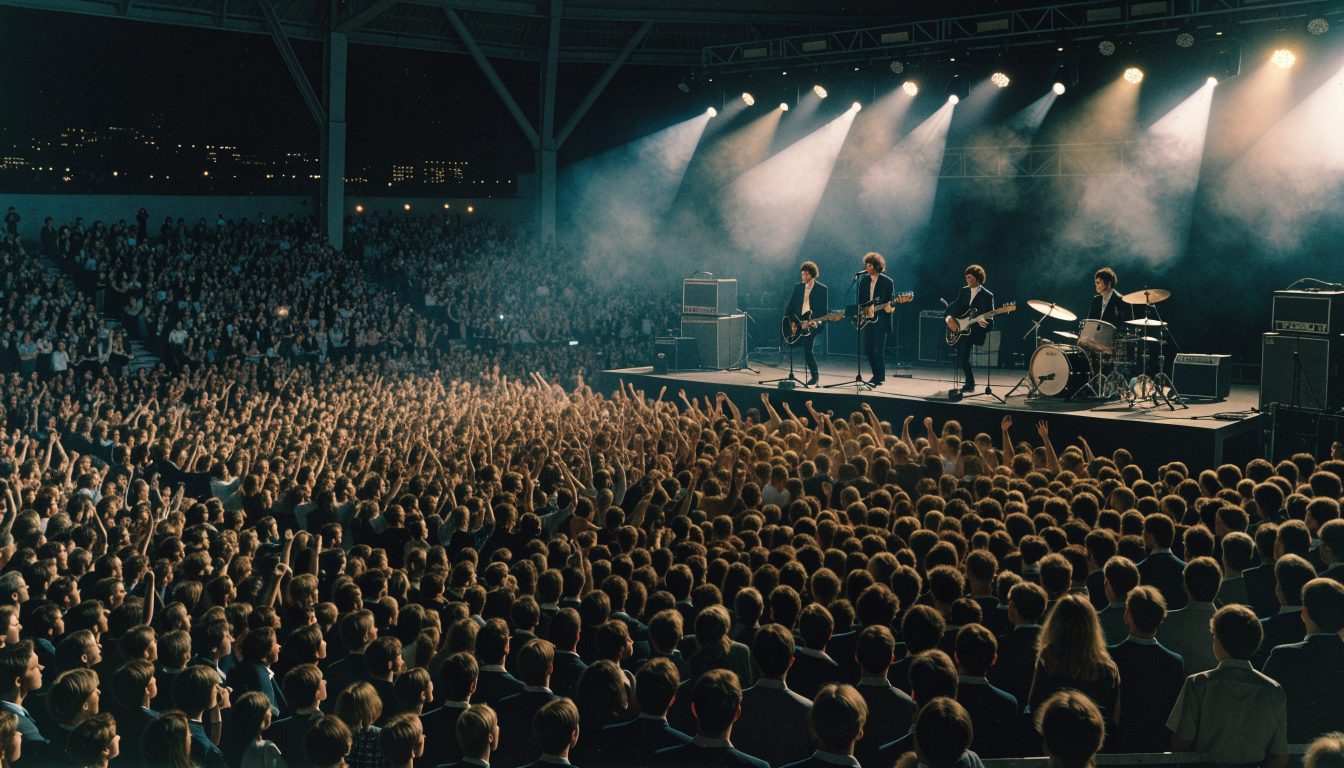
While My Guitar Gently Weeps is a George Harrison song that the Beatles released on their double album The Beatles, better known as the White Album, on November 22, 1968. Eric Clapton played the lead guitar on it without a credit. It is one of the best known songs Harrison wrote. Rolling Stone placed it on its list of the 500 greatest songs of all time.
Harrison started it in the spring of 1968, soon after the band got back from studying Transcendental Meditation with the Maharishi Mahesh Yogi in India. He was staying with his parents in Warrington, Cheshire. He was reading the I Ching, the Chinese Book of Changes. He took from it the idea that everything is linked to everything else and that nothing happens by chance. To test the idea, he opened a book at random and built a song around gently weeps, the first words he saw.
The lyrics changed over the following months. A demo he taped at his house in Esher has a verse that never made the final record. On July 25, 1968, he recorded a first take at EMI Studios in London on his own. He played a Gibson J-200 acoustic guitar. A harmonium was overdubbed on top. That version came out in 1996 on Anthology 3.
The rest of the band did not show much interest in the song at first. They cut a full group version on August 16. The overdub session on September 3 was the first time the Beatles worked on an eight-track machine at EMI. Harrison was still not happy with how it sounded. On September 5 the band started the track again from scratch. Ringo Starr had walked out of the group on August 22. He came back for that session.
Harrison asked Clapton, a close friend, to come to the studio and play on the song. Clapton said at first that nobody played on Beatles records. He agreed to come. On September 6 he overdubbed the lead guitar part on Lucy, a red Gibson Les Paul he had recently given Harrison. Harrison later said that the other Beatles behaved better with a guest in the room. The session went smoothly. Clapton asked for the part to sound more like the Beatles. Engineer Chris Thomas ran the guitar through an artificial double tracking circuit in the final mix on October 14. He moved the oscillator by hand to give it a slight wobble.
The finished track is much heavier than the quiet acoustic take from July. Harrison sang a double tracked lead vocal and also played acoustic guitar and Hammond organ. John Lennon played electric guitar with tremolo. Paul McCartney sang harmony and played piano and bass, including a second bass part on a Fender Jazz Bass. Starr played drums, tambourine and castanets. The song is the seventh track on the White Album, near the end of side one.
It was never a single in Britain or the United States. In several other countries it was the B side of Ob-La-Di, Ob-La-Da. That single went to number one in Australia, Austria, Switzerland and West Germany. The Australian Go-Set chart listed the two songs together as a double A side.
Its standing grew over the decades. Rolling Stone ranked it seventh on its list of the 100 greatest guitar songs and tenth among the Beatles' 100 greatest songs. Guitar World put Clapton's solo at number 42 on its 2008 list of the 100 greatest guitar solos. In 2018, The Independent ranked it first among all 30 tracks on the White Album.
Clapton and Harrison stayed close. They wrote Badge together for Cream. Clapton played the song again at the Concert for Bangladesh at Madison Square Garden on August 1, 1971. He used a Gibson Byrdland that night. He later called it a poor choice of guitar. Harrison, Starr and Clapton played it together at the Prince's Trust concert in 1987. Harrison kept it in his set for his 1991 tour of Japan. The tour produced the 1992 album Live in Japan.
Harrison died in November 2001. The song was played at several tributes to him. Clapton led it at the Concert for George at the Royal Albert Hall on November 29, 2002, with McCartney, Starr, Harrison's son Dhani and Jeff Lynne in the band. Tom Petty, Lynne, Steve Winwood, Dhani Harrison and Prince played it at Harrison's 2004 induction into the Rock and Roll Hall of Fame as a solo artist. Prince was a late addition. Petty suggested he take a solo to close the song. His solo ran close to three minutes. He threw his guitar into the air at the end of it.
Many other artists have recorded it. Jeff Healey cut a version for his 1990 album Hell to Pay with Harrison on acoustic guitar and backing vocals. It reached number 25 in New Zealand and number 27 in Canada. Peter Frampton recorded it in 2003. Todd Rundgren recorded it the same year. Toto put it on Through the Looking Glass. Santana recorded it in 2010 with India Arie and Yo-Yo Ma. Regina Spektor sang it for the 2016 animated film Kubo and the Two Strings. The ukulele player Jake Shimabukuro recorded a solo version.
The Beatles' recording is on the soundtrack of the 1987 film Withnail and I. Harrison's company HandMade Films made the film. George Martin wrote a new string arrangement over the July 1968 acoustic take for the 2006 album Love, made for the Cirque du Soleil show in Las Vegas. Song IQ lists the song's key and BPM.