Beautiful Day by U2
U2 built the song out of a stalled track called Always after Brian Eno and Daniel Lanois recorded a new drum machine rhythm and guitar part before the band came into the studio.
Beautiful Day is a song by the Irish band U2, released on October 9, 2000, as the lead single from their tenth album, All That You Can't Leave Behind. It went to number one in the UK, Ireland, Australia, Canada and several other countries, reached number 21 on the Billboard Hot 100, and won three Grammy Awards in 2001, including Song of the Year and Record of the Year.
The track started life in the winter of 1999 at Hanover Quay Studio in Dublin as a different song called Always. Bono brought in a chord sequence, the Edge reworked it, and the band spent several days pushing it around without getting anywhere. The Edge later said that as a straight rock song it was pretty ho-hum. Always never made the album, though it did end up as a B-side on the Beautiful Day single, next to a track called Summer Rain.
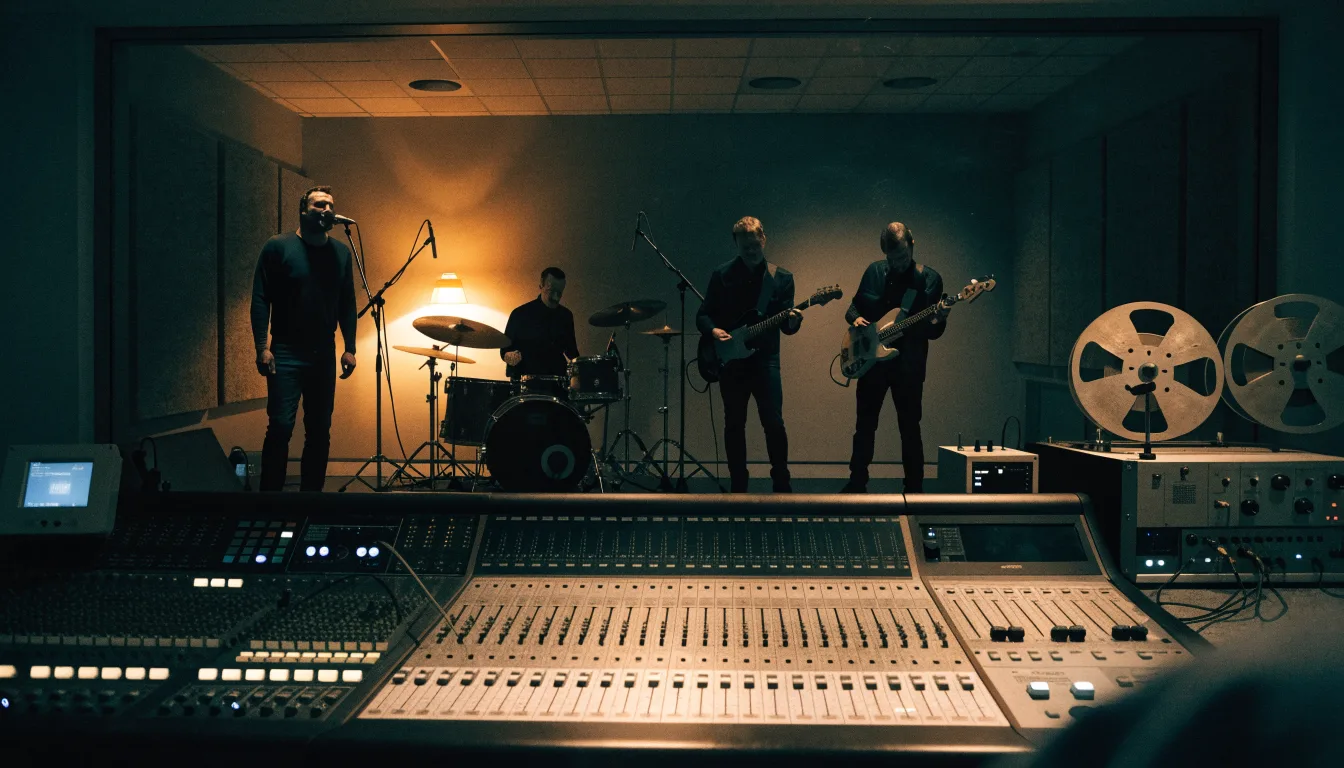
Producers Brian Eno and Daniel Lanois, who had worked with the band on The Unforgettable Fire, The Joshua Tree and Achtung Baby, came in early one day to try new ideas before the band showed up. Eno built a rhythm on a drum machine and laid piano and synthesized strings over it. Lanois played a Fender Telecaster line pitched a third above the root notes of the Edge's chords. The band started playing over that new backing track when they arrived.
Near the end of a jam that ran for about 20 minutes, Bono sang the line that became the title. After lunch, Eno and Lanois cut that phrase into the earlier parts of the recording, and it became the chorus. The Edge sang a high harmony off the cuff, Lanois added a lower part in a doo-wop style, and Eno processed both voices. Lanois described the moment as one of those small gifts that make a producer think the song is finally there.
The band argued most over the guitar sound. The Edge played the part on a Gibson Explorer with the bright, echoing tone he had used on U2's first records in the early 1980s. The rest of the band, Bono included, pushed him to find something new, since the group had spent the 1990s moving away from that sound on albums like Zooropa and Pop. The Edge kept the old tone. Bono added a guitar part that doubled the bass, the Edge changed the bass line in the chorus, and mixing took more than two weeks. Steve Lillywhite, who had produced the band's first three albums, came in to help finish it. Lanois, Eno and Lillywhite share the production credit.
The finished song runs a little over four minutes at around 136 beats per minute, and its full key and tempo details are on the Beautiful Day key and BPM page. Bono also went back to the full range of his voice after the rougher, lower style he had used through much of the 1990s.
Bono has said the song is about a man who has lost everything but still finds joy in what he has left. Part of the lyric drew on his work with Jubilee 2000, the campaign that pressed rich countries to cancel the debts of the world's poorest nations. Twenty years later, speaking at a virtual graduation event in 2020, he said the song had never described where the band was and called it a prayer for where they could go. The Edge told a Norwegian newspaper in 2000 that the song might have been partly and unconsciously inspired by a-ha's The Sun Always Shines on T.V., and a-ha singer Morten Harket said he was fine with the comparison.
The video was directed by Jonas Åkerlund and filmed in August 2000 at Charles de Gaulle Airport in Paris, with a second version shot in the French village of Èze. Critics who had grown tired of U2's late 1990s experiments mostly treated the single as a return to form. Rolling Stone later named it the ninth best song of the 2000s, and it placed fourth among singles in the Village Voice Pazz and Jop poll for 2000. The single sold more than a million copies worldwide and is certified double platinum in the UK.
The song quickly became part of U2's live show. It made its live debut in Miami on March 24, 2001, at the start of the Elevation Tour, and the band has played it at every full tour concert since. It opened their halftime show at Super Bowl XXXVI in New Orleans in February 2002, five months after the September 11 attacks. U2 also played it at the New Orleans Saints' first home game after Hurricane Katrina, at Live 8 in Hyde Park in 2005, and during their residency at the Sphere in Las Vegas. Astronaut Mark Kelly chose it as a wake-up song on the space shuttle mission STS-134.
The song has also been used on television and in political campaigns. ITV used it as the theme for its football highlights show The Premiership from 2001 to 2004, and then for The Championship until 2009. The Labour Party used it in its 2005 election campaign, it played after John Kerry's acceptance speech at the 2004 Democratic convention, and Barack Obama used it in his 2008 and 2012 campaigns. It also plays over the end credits of the 2008 film Nim's Island.
Other singers have covered it. Kurt Nilsen sang it on his way to winning World Idol in 2003, and American Idol winner Lee DeWyze's 2010 version reached number 24 on the Billboard Hot 100, a few places short of the original. In 2020 a group including Camila Cabello, Khalid, Ben Platt and Chris Martin recorded a version for a virtual commencement ceremony. U2 recorded their own stripped-back version, with a rewritten bridge, for the 2023 album Songs of Surrender.